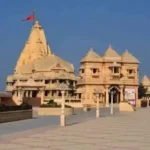
India, a land of spiritual heritage and divine legends, is home to the twelve Jyotirlingas — powerful shrines dedicated to Lord Shiva. Among these sacred temples, Mallikarjuna Jyotirlinga, nestled in the serene town of Srisailam in Andhra Pradesh, holds a special place. It is not just a Jyotirlinga; it is also one of the 18 Maha Shakti Peethas, making it a unique fusion of Shaivism and Shaktism. In this blog, we delve into the history of Mallikarjuna Jyotirlinga, explore its mythological significance, and understand why it continues to draw millions of devotees year after year.
—
Introduction to Mallikarjuna Jyotirlinga
Mallikarjuna Jyotirlinga is located on the Srisailam Mountain by the banks of the Krishna River in the Kurnool district of Andhra Pradesh. This ancient shrine is dedicated to Lord Shiva, worshipped here as Mallikarjuna, and his consort Goddess Parvati, worshipped as Bhramaramba. The temple is a part of both the Dwadasa Jyotirlinga circuit and the Ashta Dasha Shakti Peethas, making it exceptionally revered in Hindu tradition.
—
The Mythological Story Behind Mallikarjuna Jyotirlinga
The origin of the Mallikarjuna Jyotirlinga is deeply rooted in Hindu mythology. According to ancient scriptures, Lord Shiva and Goddess Parvati had two sons — Kartikeya and Ganesha. To decide who would marry first, Shiva and Parvati proposed a challenge: whoever could circle the world three times and return first would get married first.
Kartikeya, mounted on his peacock, set off to circle the world. Ganesha, however, being wise and practical, simply walked around his parents and said, “You are the entire universe for me.” Impressed by his devotion and intelligence, Shiva and Parvati declared Ganesha the winner and arranged his marriage before Kartikeya returned.
When Kartikeya heard about this, he was deeply upset and went to stay alone on Mount Krauncha. Lord Shiva, saddened by his son’s grief, went to console him along with Parvati. The place where Shiva and Parvati appeared to meet Kartikeya is believed to be Srisailam, and the divine presence they left behind became known as Mallikarjuna Jyotirlinga.
—
The Name “Mallikarjuna” – Its Divine Significance
The name “Mallikarjuna” is a combination of two divine entities:
Mallika refers to Goddess Parvati.
Arjuna is another name for Lord Shiva.
Together, Mallikarjuna signifies the divine union of Shiva and Shakti, a central theme in Hindu philosophy. The temple is one of the rare places where both deities are worshipped side by side, enhancing its spiritual aura.
—
Historical and Cultural Significance
The Mallikarjuna Temple has a rich historical background. References to the temple can be found in ancient texts like the Skanda Purana, Shiva Purana, and Padma Purana. These texts describe Srisailam as a sacred teertha (holy place) where Lord Shiva resides eternally.
Historically, the temple has been patronized by several dynasties:
The Satavahanas were among the earliest known patrons.
The Chalukyas, Kakatiyas, Vijayanagara rulers, and Reddy kings also contributed to the development of the temple complex.
The Vijayanagara emperor Krishnadevaraya is known to have visited and offered endowments to the temple.
These rulers not only maintained the temple’s religious prominence but also enhanced its architecture and cultural value. The carvings, inscriptions, and gopurams (towering gateways) reflect the evolution of South Indian temple architecture through the ages.
—
Architectural Brilliance of the Mallikarjuna Temple
The Mallikarjuna Temple is a masterpiece of Dravidian architecture. Spread over a vast area, the temple features intricately carved pillars, majestic gateways, and ornate sanctums. The main sanctum (garbhagriha) houses the self-manifested Jyotirlinga of Lord Mallikarjuna. Close to it lies the shrine of Goddess Bhramaramba, believed to be one of the 18 Shakti Peethas, where the upper lip of Goddess Sati is said to have fallen.
Another notable architectural feature is the Mukha Mandapam, a beautifully designed hall used for rituals and spiritual gatherings. The temple also includes sub-shrines, sculptured corridors, and mandapas with inscriptions from various dynasties.
—
Spiritual Importance and Pilgrimage
Mallikarjuna Jyotirlinga is considered a Moksha Dham, a place where one can attain liberation (moksha) from the cycle of birth and death. It is believed that a single visit to the temple, with devotion and faith, washes away sins and grants divine blessings.
Major festivals celebrated here include:
Mahashivaratri
Navaratri
Kartika Deepam
Shravana Masam
During these festivals, thousands of devotees perform abhiṣekham, rudrabhishekam, and other rituals to seek the divine grace of Mallikarjuna and Bhramaramba.
—
How to Reach Mallikarjuna Jyotirlinga
Srisailam is well-connected by road and has access to nearby cities like Hyderabad (around 215 km), Kurnool, and Nandyal. The nearest railway stations are in Markapur Road and Cumbum, and the closest airport is Rajiv Gandhi International Airport, Hyderabad.
—
Conclusion
The history of Mallikarjuna Jyotirlinga is not just a tale from the past — it is a living tradition that continues to inspire and uplift the spiritual consciousness of devotees. Combining mythological depth, architectural brilliance, and immense spiritual power, this temple is truly a jewel in India’s religious landscape.
Whether you are a pilgrim seeking divine blessings or a traveler interested in ancient history, Mallikarjuna Jyotirlinga offers a soul-stirring experience. Visit this sacred shrine to witness the eternal love of Shiva and Shakti and to connect with the divine energy that has transcended time.